i LA DESIGNS specialty
is a genuine Classic Buon Fresco Techniques. We offer Buon
(true) Fresco, Secco Fresco and Faux Fresco. We create frescoes as
Full scale walls and ceilings
Movable panels
Decorative True Fresco Fragments
iLia Anossov is one of
the very few fresco masters now living in the USA. iLia is the
founder of the Fresco School and Contemporary Fresco Painting
resource Center at TrueFresco.com. He is a speaker and a judge for a
prestigious Fauxcademy Awards. "Albuquerque Fresco" by iLia Anossov
is the largest contemporary buon fresco in Western USA.
Affresco ( In
English usage, "fresco" ). Painting done on freshly laid wet
plaster with pigments dissolved in lime water. As both dry they
become completely integrated. Known as buon "true" fresco,
this technique was a primary choice for Grand Palaces and Public Centers as well as private homes throughout the known hystory. In Western Art it is the formost important technique of the Renaissance (late thirteenth to the
mid-sixteenth centuries).
The common assumption
that all mural painting is fresco painting is an erroneous idea. It
is true that one can in fact paint on fresh plaster, or intonaco, to
make a painting in affresco or a fresco. In true fresco the artist
must start applying his colors on the wet (or fresco) intonaco as
soon as it has been prepared and laid on the wall. The colors can
thus be absorbed by the wet plaster. When it dries and hardens, the
colors become one with plaster. Technically speaking the plaster
does not "dry" but rather a chemical reaction occurs in which
calcium carbonate is formed as a result of carbon dioxide from the
air combining with the calcium hydrate in the wet plaster.
Visit
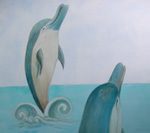
www.DolphinFresco.com to see
step-by-step illustrated journal of the creation of a true (buon) fresco.
Secco, also known
as "fresco secco" or "dry fresco," is a method of mural painting
in which pigments are applied to dry plaster. The whole work may be
secco or secco may be used for additional details or corrections to
works which are "true fresco." Traditionally Pigments are mixed with
egg yolk or egg white (depending on artist preference) or adhesive
such as gum arabic, casein, animal glue ore more contemporary
acrylic mediums resulting in somewhat "tempera like" paint. The
consistency of the paint should be also as thin as for buon fresco
technique and not as "thick" as it is customary for an acrylic
mural.
Faux Fresco Mural - painting done mainly on non-plaster support
using variety of materials, including plasters and faux painting
techniques, including distressing to simulate/imitate the "look and
feel" of the "worn out" aged Fresco (Buon or Secco).
Look
and Feel of the aged true fresco has always been "in style"
and in high demand. In Recent years rise in popularity of Fresco
Painting, authentic "Old World" decorative painting techniques and
historic plaster finishes lead to especially high demand for an
"aged fresco look" without the "fresco expense" which our imitation
- Faux Fresco techniques provide.
Steps
in Creation of the Buon Fresco:
1. Development of the
composition - initial BW rendering/drawing is produced for the
client for the initial approval of the composition and to personalize
the elements of the fresco. When all elements of the fresco become clear
to both parties, final detailed rendering and/or scaled color study is
developed and delivered to the patron for the Final Rendering Approval.
(When necessary, images of the "work in progress" are also posted in
CLIENT CENTER.)
2. Cartoon and Color
Studies - after
the final rendering is approved by the client we begin the development
of the "Cartoon" - full scale drawing of the future fresco and full
scale color studies of the major elements of the fresco. There will be a
minimum of two (initial and final) scheduled in-studio client screenings
during the work on the Cartoon. (For patron's convenience images of the
"work in progress" are provided, when necessary for in-town and
regularly for out-of-town projects.)
Initial Cartoon
Screening - after the initial values of the fresco (background,
composition, layout of the details) have been developed client is
invited to the studio to confirm the overall appearance of the future
fresco. At this stage secondary changes and adjustments can be proposed
by the patron. (for out-of-town projects we use high quality
professional photographs that are delivered via FedEx)
3.
Wall Preparation
- wall preparation
generally begins after the "Initial Cartoon Screening" and depending on
the specifics of the project consists of - building of the Fresco Wall
from scratch and/or Building of Supporting Fresco Plaster coats.
Final Screening -
before "transfer tracings" of the final Cartoon are prepared client is
invited to the studio for the Final Cartoon Screening. (for out-of-town
projects we use high quality professional photographs that are delivered
via FedEx)
4. Painting -
buon fresco painting begins with "Sinopia". Sinopia is later covered
section by section with "intonaco" plaster on which the actual buon
fresco painting is done. Sinopia serves as a reference guide for
positioning "giornatas" as artist progresses through the work.
--"sinopia" - a full scale
monochrome rendering of fresco on "arriccio"
--"arriccio" - plaster coat preceding the "intonaco"
--"intonaco" - final plaster coat the fresco is painted on
--"giornata" - a section of fresco painted in one day
Alternatively fresco can be painted in-studio on our custom designed
collectable panels or Decorative fresco fragments and installed on
location. Buon Fresco panel is securely mounted on the wall with the
frame visible (we offer a selection of styles), or inserted into the
wall.
"He
transformed a thirty-foot wall into a living display of
beauty that will outlast most of the art and architecture of
the Southwest. He is a creative genius and works with a
wonderful team..."
A. B., Emmy Award Winning Documentary Producer (Best Public
Affairs) ABTV